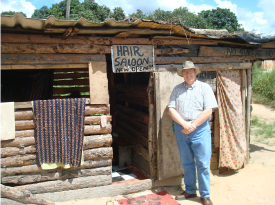
 We began deputation and had 4 meetings before our trip to Zambia. The trip to Zambia was nothing short of amazing. John was able to lead a 79 year old witch doctor possessed with two devils to Christ! I was given the privilege to lead four ladies to Christ at a ‘hair saloon’ (Zambian spelling). They yelled out for a tract and then stopped working for 40 minutes as I preached to them. One by one they walked out of the little booth into the back yard and knelt around an old tire. One by one they called on Jesus to save them! Hallelujah!
In the short time we were there, we were asked to start churches in Kitwe, Ndola, around the mission station, 3 hours from the mission station, in the DR Congo, in Mozambique, and in Zimbabwe. We quickly understood what Bobby Bonner had been telling us. The people are crying out for God. Who will come and help us?
We were quickly faced with a totally new challenge, one we had never thought of while pastoring in the USA. How do you tell people you will NOT come and help them? With calls to help from all directions, we quickly understood the need to be led of God and to minister with purpose. If Africa will be reached, we MUST identify what is the limiting factor and focus on that.
Dear ReadersConsidering the emerging cheallnges of a new economy, the limitations of our human rights instruments, and the limitations of current disability-related investments in enabling inclusion, what strategies can be used globally to advance the human rights and inclusion of people who have a disability in our societies?• All people are people first and must be treated with dignity and respect and be accepted.• Each person must be recognised as the person they are.• All individuals must have the right to make their own decisions and to have these decisions respected.• From birth, every human has the same worth.• All people have the right to be valued as an equal in their own community.From, “The Beliefs, Values and Principals of Self-Advocacy” (ILSMH 1994)This statement expresses an unequivocal demand by deaf people to be treated as equals. However the reality has been that with the exception of a small number of communities, the lives of deaf persons have been marginalized, devalued and all too often abused.The lives of deaf adults are all too often stigmatized by poverty, little or poor education, poor health care, poor housing and segregation from mainstream community life.Deaf people are grossly over represented in areas such as institutional care, discrimination in housing, unemployment and abuse.Some people with an intellectual disability lack the basic necessities of life being food, shelter and health care. A civil society can no longer accept that some deaf people will die from the effects of malnutrition, lack of health care or neglect.If all people are to live as equals in society we must:• Strengthen current human rights instruments and conventions to ensure it becomes unacceptable for communities to devalue the lives of deaf people.• Strengthen the monitoring of these human rights instruments and conventions to ensure that all people regardless of any disability or care needs are valued as equals.• Support the development of community life that is inclusive for all people regardless of their health status, care needs and ability to participate in the wider life of the community.The question remains whether the Society of non deaf/disability will live up to these standards for all and invest in inclusive development practices.Yours sincerely Frank Musukwa,Executive Director,Zambia Deaf Youth and Women,P.O. Box 20369,10101 Kitwe,Zambia.Mobile Cell: +260977 866459 (SMS)/ +260977 844886 (Voice) “DEAF RIGHTS AND EQUAL OPPORTUNITIES”